

D024 Mind Map
Student Name
Western Governors University
D024 Professional Presence and Influence
Prof. Name:
Date
D024 Mind Map:
Improving patient and nursing satisfaction requires a coordinated approach that addresses working conditions, staffing, leadership, professional development, and work-life balance. Healthcare organizations can support nurse retention and better patient care by creating respectful work environments, using appropriate staffing practices, strengthening nurse leadership, supporting professional growth, and providing nurses with greater control over their schedules. These strategies can help address workplace stress and burnout while promoting a more stable and engaged nursing workforce.
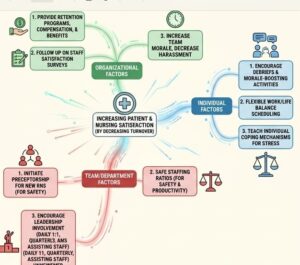
The D024 mind map on improving patient and nursing satisfaction highlights strategies at the organizational, departmental, leadership, and individual levels. Rather than relying on one intervention, healthcare organizations can combine these approaches to improve the nursing work environment and support quality patient outcomes.
Organizational Strategies for Nurse Retention and Satisfaction
Healthcare organizations have an important role in establishing conditions that encourage nurses to remain in their roles. Effective nurse retention strategies should address compensation, benefits, career development, recognition, communication, and opportunities for advancement.
Competitive compensation and comprehensive benefits can help organizations attract and retain qualified nurses. Career pathways can also give nurses opportunities to develop clinical and leadership skills while working toward their professional goals.
Communication between organizational leaders and nursing staff is equally important. Employee surveys, focus groups, staff meetings, and other feedback mechanisms can help leaders identify workplace concerns. However, gathering feedback alone is not enough. Nurses are more likely to feel heard when leaders communicate the actions taken in response to their concerns.
A healthy organizational culture should also promote respectful communication, teamwork, psychological safety, and professional accountability. Workplace incivility, bullying, and harassment should be addressed promptly because negative workplace behaviors can interfere with collaboration and employee well-being.
Department-Level Strategies to Support Nurses
The nursing unit is where many workplace experiences occur, making department-level interventions particularly important. Nurse managers can improve satisfaction by addressing workload, staffing, teamwork, communication, and support for staff members.
Safe and appropriate staffing is a major consideration. Staffing decisions should account for patient acuity, care complexity, nurse experience, workload, and skill mix rather than depending exclusively on a fixed nurse-to-patient ratio. Appropriate staffing can help nurses deliver timely care while reducing excessive workload and fatigue.
Structured onboarding and preceptorship programs can also support nurses who are new to a unit or transitioning into professional practice. Experienced nurses can provide clinical guidance, feedback, and encouragement, helping new staff members build confidence and become integrated into the healthcare team.
Nurse managers should maintain regular contact with staff through rounding, check-ins, and one-on-one conversations. Visible and responsive leadership allows managers to identify workload concerns and operational problems early. During periods of increased patient demand, leaders can also help coordinate resources and address barriers affecting patient care.
Individual Strategies for Preventing Nurse Burnout
Individual well-being is another component of nursing satisfaction, although personal strategies should not replace organizational responsibility for safe workloads and healthy working conditions.
Nurses may benefit from peer support, team-building activities, and opportunities to debrief after difficult clinical situations. Discussing challenging experiences with trusted colleagues can strengthen professional relationships and reduce feelings of isolation.
Healthy stress-management practices may also support nurses in managing the demands of clinical practice. Depending on individual needs, these may include adequate sleep and recovery time, physical activity, mindfulness, social connections, and appropriate use of workplace wellness resources.
Organizations can strengthen these efforts by making support resources accessible and creating a workplace culture where asking for help is considered an appropriate professional behavior.
Work-Life Balance and Flexible Scheduling
Work-life balance can influence nurses’ job satisfaction and decisions about remaining in a position. Rotating shifts, long working hours, and unpredictable schedules may make it challenging for nurses to manage family responsibilities, education, personal commitments, and recovery between shifts.
When operationally feasible, healthcare organizations can provide scheduling options that give nurses greater predictability and control. Examples include self-scheduling, predictable scheduling practices, shift-swapping policies, and other flexible scheduling arrangements.
Scheduling flexibility should be balanced with patient-care requirements and staffing needs. When implemented effectively, flexible scheduling can help nurses manage professional and personal responsibilities while supporting workforce stability.
Nursing Leadership and Employee Engagement
Nurse leaders influence the everyday work environment through communication, recognition, decision-making, and support. Effective leadership involves establishing clear expectations, listening to staff concerns, recognizing contributions, providing constructive feedback, and responding to workplace challenges.
Leadership engagement can also increase nurses’ involvement in decisions affecting clinical practice. Nurses who participate in practice improvement and workflow decisions can contribute frontline knowledge that may help organizations identify practical solutions to patient-care and operational challenges.
Shared decision-making is particularly useful when organizations are developing policies, procedures, or quality-improvement initiatives that directly affect nursing practice.
Professional Development and Career Advancement
Professional development can help nurses maintain clinical competence while working toward long-term career goals. Healthcare organizations can support professional growth through continuing education, specialty training, mentoring, leadership development, and career advancement programs.
Professional development can also contribute to employee engagement by demonstrating that the organization values nurses’ knowledge and future growth. Providing opportunities to develop new skills may help nurses pursue specialty or leadership roles without having to leave the organization to advance their careers.
Mentorship programs can further strengthen professional development by connecting less-experienced nurses with experienced professionals who can provide guidance, feedback, and career support.
How Patient Satisfaction Connects With Nursing Satisfaction
Patient and nursing satisfaction are closely connected to the overall healthcare environment. Nurses who have adequate resources, effective teamwork, supportive leadership, and manageable workloads may be better positioned to communicate with patients, coordinate care, and respond to patient needs.
Improving nursing satisfaction should therefore be viewed as part of a broader patient-safety and quality-improvement strategy. Workforce stability can help healthcare organizations maintain experienced teams and support continuity in patient care.
At the same time, patient satisfaction depends on multiple factors, including communication, access to care, responsiveness, clinical outcomes, and the overall patient experience. Nurse satisfaction is one important component rather than the sole determinant of patient satisfaction.
Key Strategies in the D024 Mind Map
The D024 mind map for improving patient and nursing satisfaction emphasizes interventions across several levels of the healthcare organization:
Organizational level: Competitive compensation, benefits, career opportunities, employee feedback, and a respectful workplace.
Departmental level: Appropriate staffing, structured onboarding, preceptorship, teamwork, and manager visibility.
Individual level: Peer support, stress management, healthy coping strategies, recovery time, and work-life balance.
Leadership level: Communication, recognition, shared decision-making, responsive management, and staff engagement.
Professional development level: Continuing education, mentoring, specialty training, leadership development, and career advancement.
Why Nurse Retention Matters in Healthcare
Nurse retention is an important workforce issue because experienced nurses contribute clinical knowledge, teamwork, organizational familiarity, and continuity of care. High turnover can create additional recruitment and training demands and may place greater pressure on remaining staff.
Strategies that improve the nursing work environment should therefore address both immediate workplace concerns and longer-term professional needs. Supportive leadership, appropriate staffing, professional development, recognition, and scheduling flexibility can work together as components of a broader nurse-retention strategy.
D024 Mind Map: Key Takeaway
The central message of the D024 Mind Map: Improving Patient and Nursing Satisfaction is that sustainable improvement requires action at multiple levels. Healthcare organizations can strengthen nurse satisfaction and retention by combining supportive leadership, appropriate staffing, professional development, positive workplace culture, peer support, and work-life balance initiatives.
These interventions can contribute to a healthier nursing work environment while supporting workforce stability and the delivery of safe, high-quality patient care.
References
American Nurses Association. (n.d.). Nurse staffing. American Nurses Association. https://www.nursingworld.org/practice-policy/nurse-staffing/
Buchan, J., Catton, H., & Shaffer, F. A. (2022). Sustain and retain in 2022 and beyond: The global nursing workforce and the COVID-19 pandemic. International Council of Nurses. https://www.icn.ch/resources/publications-and-reports/sustain-and-retain-2022-and-beyond
D024 Mind Map
Drennan, V. M., & Ross, F. (2019). Global nurse shortages—the facts, the impact and action for change. British Medical Bulletin, 130(1), 25–37. https://doi.org/10.1093/bmb/ldz014